
Contributor´s Guidelines
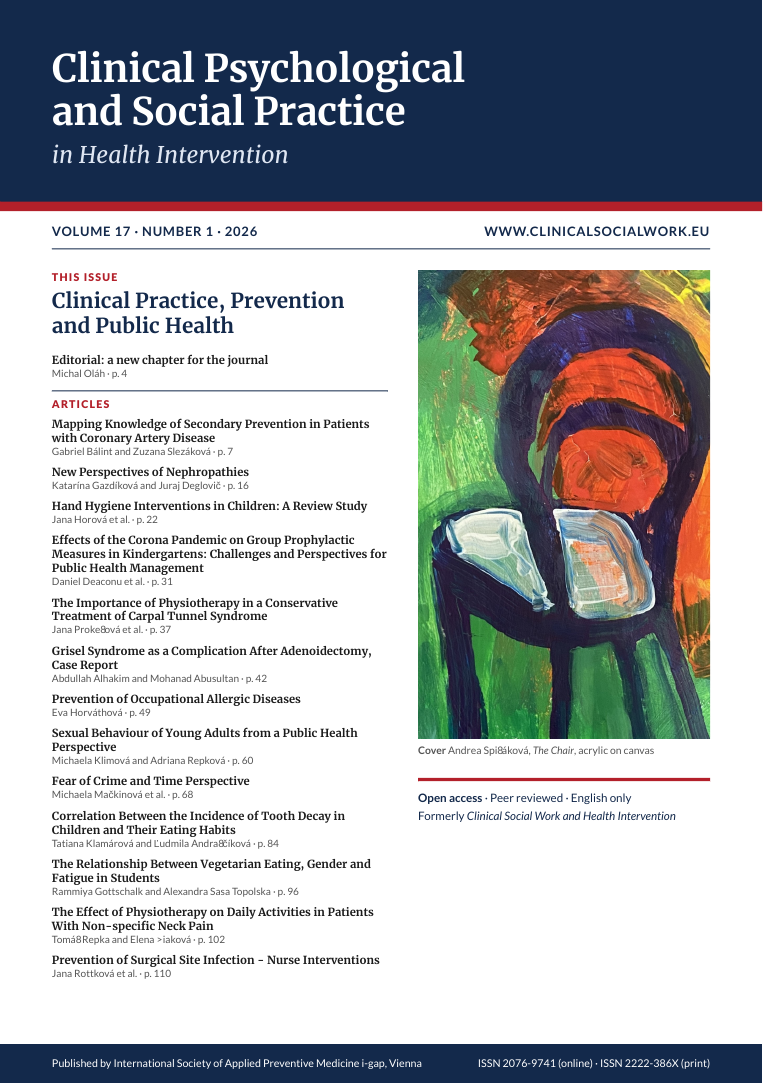
Clinical Psychology and Psychosocial Health Interventions (formerly Clinical Social Work and Health Intervention) is an international, peer-reviewed, open access journal focused on clinical psychology and health care. We welcome original research, reviews, case studies and practice reports from psychologists, physicians, nurses, therapists, social workers and other helping professionals. The journal is published by the International Society of Applied Preventive Medicine I-GAP in Vienna, Austria, since 2010 and in English only.
Fees
Publishing in the journal is free of charge. There are no submission fees and no article processing charges (APC). All articles are published in open access under the CC BY 4.0 license; authors retain their copyright.
Article types
- Original research articles – quantitative, qualitative or mixed-methods studies; up to 3,500 words; structured abstract up to 150 words.
- Review articles – systematic, scoping or narrative reviews; up to 3,500 words; systematic reviews must follow PRISMA.
- Case studies and practice reports – reflective reports from clinical, psychological and social practice; up to 2,500 words.
- Editorials and commentaries – usually invited; up to 1,500 words.
- Letters – responses to published articles; up to 800 words.
- Book reviews – up to 1,200 words, with a copy of the book cover.
Editorial policies
Authorship and contributions. All authors must meet the ICMJE authorship criteria. Each manuscript must include an author contributions statement using the CRediT taxonomy (e.g. Conceptualization, Methodology, Formal analysis, Writing – original draft). Authors are encouraged to provide their ORCID iD.
Ethics approval and informed consent. Research involving human participants must have been approved by a research ethics committee and conducted in accordance with the Declaration of Helsinki (latest revision). The name of the committee and the approval number must be stated in the Methods section, together with a statement on informed consent. Particular care is required when working with vulnerable groups (e.g. people with addictions, Roma communities, refugees, minors).
Reporting guidelines. Authors should follow the reporting guideline appropriate to the study design, available from the EQUATOR Network: CONSORT for randomised trials, STROBE for observational studies, PRISMA for systematic reviews, COREQ or SRQR for qualitative research, CARE for case reports. Sex and gender should be reported according to the SAGER guidelines. Clinical trials must be registered in a public registry before enrolment of the first participant and the registration number given in the abstract.
Data availability. Every research article must include a data availability statement describing whether, where and under what conditions the data underlying the results can be accessed (e.g. a public repository such as Zenodo, available on reasonable request, or not available for ethical reasons).
Funding and conflicts of interest. Authors must disclose all sources of funding and the role of the funder in the study, and declare any competing interests (financial or non-financial) using the ICMJE disclosure categories. If there are none, the statement “The authors declare no competing interests” must be included.
Preprints. Posting a manuscript on a preprint server (e.g. PsyArXiv, SocArXiv, medRxiv) before or during submission is permitted and does not count as prior publication. After publication, the preprint should be linked to the article DOI.
Use of artificial intelligence. AI tools cannot be authors. Any use of generative AI in writing or analysis must be described in the manuscript; authors remain fully responsible for its content.
Language. Manuscripts must be written in clear English. Authors whose first language is not English are advised to have the text checked before submission.
Editorial independence and advertising. Editorial decisions are made solely on academic merit by the Editor-in-Chief and the editorial board, independently of the publisher and of any funders. The journal does not publish advertising.
Submission checklist
- Title page with all authors, affiliations, ORCID iDs and corresponding author’s e-mail.
- Structured abstract (Objective, Design, Participants, Methods, Results, Conclusion) and 3–6 keywords.
- Anonymised manuscript for double-blind review (no author names in the text or file properties).
- Statements: ethics approval and consent, author contributions (CRediT), funding, competing interests, data availability, use of AI.
- Completed reporting checklist where applicable.
Editorial plan for 2027
Issue 1/2027: Mental Health in Clinical, Psychological and Social Practice
Issue 2/2027: Health and Social Inclusion of Roma Communities
Issue 3/2027: War, Armed Conflict and Their Psychosocial and Health Consequences
Issue 4/2027: Resilience to Stress in Clients and Helping Professionals
Contributions outside these themes that fit the scope of the journal are also welcome.
Your contribution should fit into the following structure:
-
- Editorial
-
- Review
-
- Original Article
-
- Letters
Instructions for contributors:
All articles must be in accordance with the current language standards in English, current ISO and the law on copyrights and rights related to copyrights.
Your contributions are to be sent via e-mail (addressed to: cswjournal@gmail.com) as an attachment. Manuscripts should be submitted as MS Word documents.
Style Sheet Requirements:
Maximum length: 3,500 words
Letter type: Times New Roman
Letter size: 12
Lining: 1
All articles must include:
Name of the article and author’s address in English
Article abstract of 150 words in English
Brief professional CV of the author (100 words)
Publishing language: English only
Text of the article consisting of at most 3500 words
Review process:
- Every article accepted by the journal first goes through an anti-plagiarism program and a review by the Crossref platform, which our journal is a part of. On average, we return about 10% of articles to authors at this stage due to plagiarism. Any article that is submitted to our editorial office and turns out to be plagiarized is rejected without the possibility of correction and resubmission for publication. The author responsible for an article that turns out to be plagiarized is banned from publishing in our journal for a year.
- We only accept articles in English for consideration. The second step is sending the articles for proofreading. In case of unintelligible, poor quality or ungrammatical English, the article is returned to the authors for revision. About 15% of articles are sent back to the authors for this reason.
- After the anti-plagiarism and language checks, articles are reviewed by an editorial board headed by the Editor-in-Chief, Daniel J. West, Jr. PhD, FACHE, FACMPE (Department of Health Administration & Human Resources, Panuska College of Professional Studies, 417 McGurrin Hall, Scranton – Pennsylvania, 18510-4597), who assesses the articles for consistency with the journal’s professional focus and editorial plan for the year. After this step, around 20% of the texts are either rejected or sent for revision.
- After articles are selected, the texts are sent for a double-blind review process (the identities of authors and reviewers are concealed from each other), where at least two reviewers assess the quality of the texts. We try to select reviewers from two different continents, e.g., the USA and Europe, Europe and Africa, etc., to ensure as much transparency as possible in the entire review process.
- After positive reviews, a manuscript is accepted for publication, sent for revision or returned to the authors as professionally eligible for publication in our journal. Around 50% of the articles are sent back to the authors for these reasons.
- After a successful review process, the article is accepted and scheduled for publication. The final decision is made by the Editor-in-Chief on the basis of the reviews; authors may appeal a decision by writing to the editorial office.
- It is very important for us to avoid any unethical behavior, predatory practices among journals or entering into citation cartels. Our journal is therefore governed by a code of ethics that was approved by our editorial board: https://cpphi.eu/
code-of-ethics/ .
Article abstract should fit into the following structure:
-
- Objective
-
- Design
-
- Participants
-
- Methods
-
- Results
-
- Conclusion
Example of a Structured Abstract
Abstract:
OBJECTIVE: The aim of our research was to determine the effect of Speleotherapy on the quality of life, anxiety and depression in patients with COPD.
DESIGN: Pilot study.
PARTICIPANTS: The 128 patients with CPOD participated in the study (average age 64.05), examined during a spa treatment in a sanatoriums in the High Tatras. The experimental group (29 patients) completed spa treatment and Speleotherapy in the Belianska Cave. The control group (99 patients) completed a spa treatment without Speleotherapy. All patients were examined on admission and discharge, for an average 20-day treatment stay. Original Articles 8 Clinical Psychology and Psychosocial Health Interventions Clinical Psychology and Psychosocial Health Interventions Vol. 7 No. 2 2016
METHODS: They were evaluated on the basis of the quality of life (SGRQ), Beck and Zung, the Spirometric Test (FEV1 and FEV1/FVC) and the 6-minute Walk Test.
RESULTS: After the treatment, concerning the patients of the experimental group we recorded that within the evaluation of quality of life there was significant improvement in symptoms (p<0.05). There was also statistically significant improvement in anxiety and the six-minute Walk Test (p<0.05).
CONCLUSION: The pilot study shows that spa treatment along with Speleotherapy improves the quality of life and anxiety in patients with COPD. However, there is a need for prolonged study with more patients in order to demonstrate the effectiveness of this therapy.
Each article must be an original never published before. When using references, parts of other articles or publications it is inevitable to quote them and provide information about the source.
We reserve the right to formally edit and reduce the text if needed. Academic articles undergo an anonymous critique. Each author will receive a prior statement of publishing his/her article. Reference styles writing: “name and year”.
When writing a review it is necessary to attach a copy of the cover of the book.
Published Statement of Human and Animal Rights
When reporting experiments on human subjects, authors should indicate whether the procedures followed were in accordance with the ethical standards of the responsible committee on human experimentation (institutional and national) and with the Declaration of Helsinki in its latest revision.
Published Statement of Informed Consent
Patients / clients have a right to privacy that should not be infringed without informed consent. Identifying information, including patients’ names, initials, or hospital numbers, should not be published in written descriptions, photographs, and pedigrees unless the information is essential for scientific purposes and the patient (or parent or guardian) gives written informed consent for publication. Informed consent for this purpose requires that a patient who is identifiable be shown the manuscript to be published. Authors should identify Individuals who provide writing assistance and disclose the funding source for this assistance.
Identifying details should be omitted if they are not essential. Complete anonymity is difficult to achieve, however, and informed consent should be obtained if there is any doubt. For example, masking the eye region in photographs of patients is inadequate protection of anonymity. If identifying characteristics are altered to protect anonymity, such as in genetic pedigrees, authors should provide assurance that alterations do not distort scientific meaning and editors should so note.
Published Conflict-of-Interest Statement
Public trust in the peer review process and the credibility of published articles depend in part on how well conflict of interest is handled during writing, peer review, and editorial decision making. Conflict of interest exists when an author (or the author’s institution), reviewer, or editor has financial or personal relationships that inappropriately influence (bias) his or her actions (such relationships are also known as dual commitments, competing interests, or competing loyalties). These relationships vary from those with negligible potential to those with great potential to influence judgment, and not all relationships represent true conflict of interest. The potential for conflict of interest can exist whether or not an individual believes that the relationship affects his or her scientific judgment. Financial relationships (such as employment, consultancies, stock ownership, honoraria, paid expert testimony) are the most easily identifiable conflicts of interest and the most likely to undermine the credibility of the journal, the authors, and of science itself. However, conflicts can occur for other reasons, such as personal relationships, academic competition, and intellectual passion.
Thank you for your cooperation
Yours sincerely,
Michael Olah
Dr.hc. Mult. Dr. Daniel J. West, Jr. PhD, LFACHE, FACMPE
ISSN 2076-9741 (online)
ISSN 2222-386X (print)
Indexed in


Scientific partners
Alexander Street – a ProQuest company
International Journal of Prenatal and Perinatal Psychology and Medicine